What is a Web Browser?
Many confuse the term web browser with search engine as this video clearly demonstrates. I was actually a little surprised after watching that video but then when I stopped to think about it and I remembered the responses I got when I asked friends and family, Do you know what a browser is? I said, Yup. That video pretty much nailed it. The plain fact of the matter is...
Most people don't know what a web browser actually is.
So here we go...
A web browser —plain and simple— is a computer program that fetches and displays web pages. Any web page. The web page you are viewing now is displayed inside a web browser. The primary task of a web browser is to use a web address to send out a request over the internet to the appropriate web server where a web page file resides and then use those coded instructions to display text, graphics and/or videos in a window on your computer screen.

When you start your web browser, say for example by clicking on the big blue 'e' on your desktop, your browser automatically fetches your favorite home page and displays it in the browser window. This creates the illusion of 'turning on the internet' but really all you're doing is starting up a computer program. That's it, that's all. It's no different from any other program installed on your computer in that it deals with a specific kind of content and displays it in a graphical user interface.
Most web browser home pages are configured by default to be either a web portal like MSN (which includes the Bing search box at the top) or an actual search engine such as Google. From there the user's internet browsing experience begins and hence the confusion between a web browser and a search engine.
Just to clarify further...
A search engine is actually a web page that allows you to enter search terms and display a list of websites related to your search term. The plain fact of the matter is, you actually need a web browser (a computer program) to display a search engine (a web page). Hence they clearly cannot be one and the same.
Here's a list of the most commonly used web browsers:
These can all be downloaded for free since the days of actually paying for a web browser are pretty much over.
So now you may be wondering what web browser am I actually using? To find out, click on the button below:
At the time of this writing, most people are using Internet Explorer 8 so we'll use that as an example.
Here's a screenshot of the Iron Spider home page displayed in Internet Explorer 8.
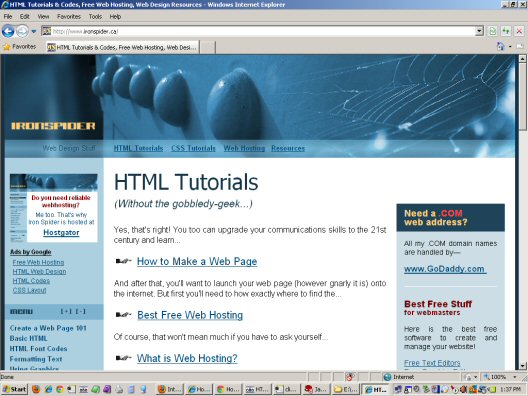
Now visually speaking, exactly what constitutes the web browser is the menu bar, toolbars, address bar, buttons and borders of the Internet Explorer user interface.
This is highlighted in red in the screenshot below:
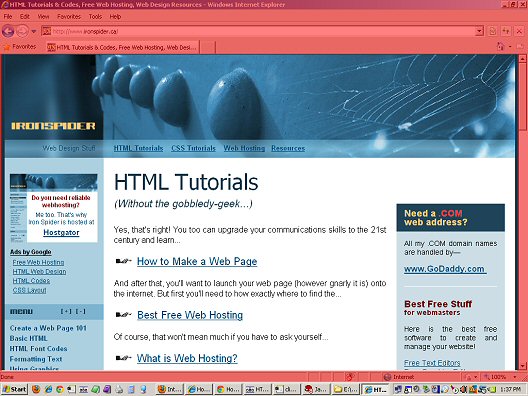
This is what is known in geekspeak as the browser chrome.
Everything else inside the red borders is commonly known as the browser viewport which displays the web pages you surf to. You do this by either clicking on a hyperlink on another web page or by typing a web address into the address bar and hitting the Go button.
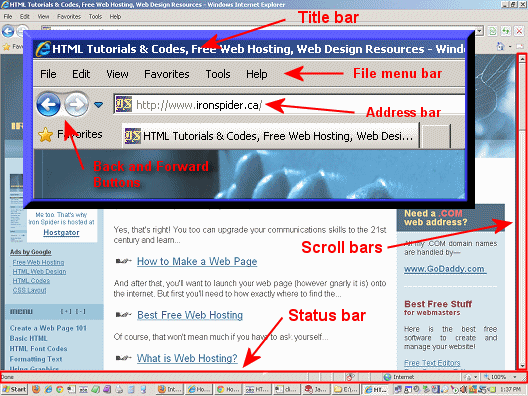
Traditionally, all web browsers displayed the same assemblage of buttons and bars running across the top of the browser which facilitated some basic navigational functions including a back button (return to the previous page), a forward button (go to the next page), a refresh button (reload the current page), a stop button (stop loading the current page), an address bar and a file menu bar. They also included a status bar running across the bottom and scroll bars on the side.
Once you've clearly made the distinction between a web browser and a web page then you're on your way to becoming a professional webmaster because you'll realize that you don't have to use your web browser to just surf the internet. It can in fact be used to open any web page document that resides on your own computer. So you could create web pages, save them to your own computer and then test drive them in your web browser. You don't even need to be hooked up to the internet to do this.
For more information on this, please see the following pages:
Browsers and Web Standards
Recently, with their latest updates, web browser makers have been doing away with the File menu bar to save screen space and provide a less clunky user interface (although not all agree with these changes) and, in some extremes as in Google Chrome, even doing away with the Title bar and the Status bar.
This is all part of the drive that web browser makers are constantly engaged in to entice more users to switch over to their browser in order to increase their percentage of total browser users, also known as market share or browser usage share. This battle over browser usage share has been going on since the mid 90's and is commonly known as the browser wars.
Now, as you become more adept at creating web pages, you may discover an issue with how different web browsers interpret your HTML coding and display your web pages. This is much less of a problem nowadays as compared to what was going on in the heyday of the browser wars or even as little as four or five years ago. This was a time when alternative web browsers like Firefox and Opera were more likely to be what is known as standards compliant. In other words, they were more likely to render HTML and CSS coding exactly as laid out according to their official specifications.
For example, the CSS file for Iron Spider's old tableless design required numerous CSS hacks to wrestle with both Internet Explorer and Firefox to get them to display my web design identically. The Iron Spider web design you're currently viewing, on the other hand, has only one CSS hack in the entire external style sheet. So things have come along way, in my humble opinion. They're not perfect but they've improved a lot.
But it doesn't matter how good web browsers get at displaying web pages uniformly. Your job as a webmaster will be to always check your web pages in all the major web browsers to make sure everything is copesthetic. Otherwise you could be turning away a significant portion of potential visitors to your website because your web design went haywire in a particular web browser and either looked butt-ugly or worse, had illegible text or misplaced components.
The next pages in this section of Iron Spider are devoted to providing an overview of all the major web browsers in use at the time of this writing...
| Last updated: Monday October 10, 2011 |
Learn about web hosting without the technobabble!
What is Web Hosting?
Best Free Web Hosting
Affordable Domain Names
Affordable Web Hosting
See also:
How to Make a Web Page
Free Website Templates
If you need a .COM web address, you can get one quick and easy at...
| HOME | TOP | NEXT ~> |